
Cyber Resilience Starts at the Top
Cyber security is often treated as a technical issue, but cyber resilience is a leadership responsibility. If an organisation expects good security behaviour, clear accountability and consistent controls, that direction has to come from the top.
Cyber resilience is not just an IT issue
Many organisations still see cyber security as something owned by IT. That creates a problem. IT may manage systems, apply patches, configure devices and support users, but they cannot own every business decision that creates cyber risk.
Senior leaders decide how the organisation operates. They approve budgets, choose suppliers, set priorities, define acceptable risk and decide how quickly issues are addressed. Those decisions shape cyber resilience more than any single tool or technical control.
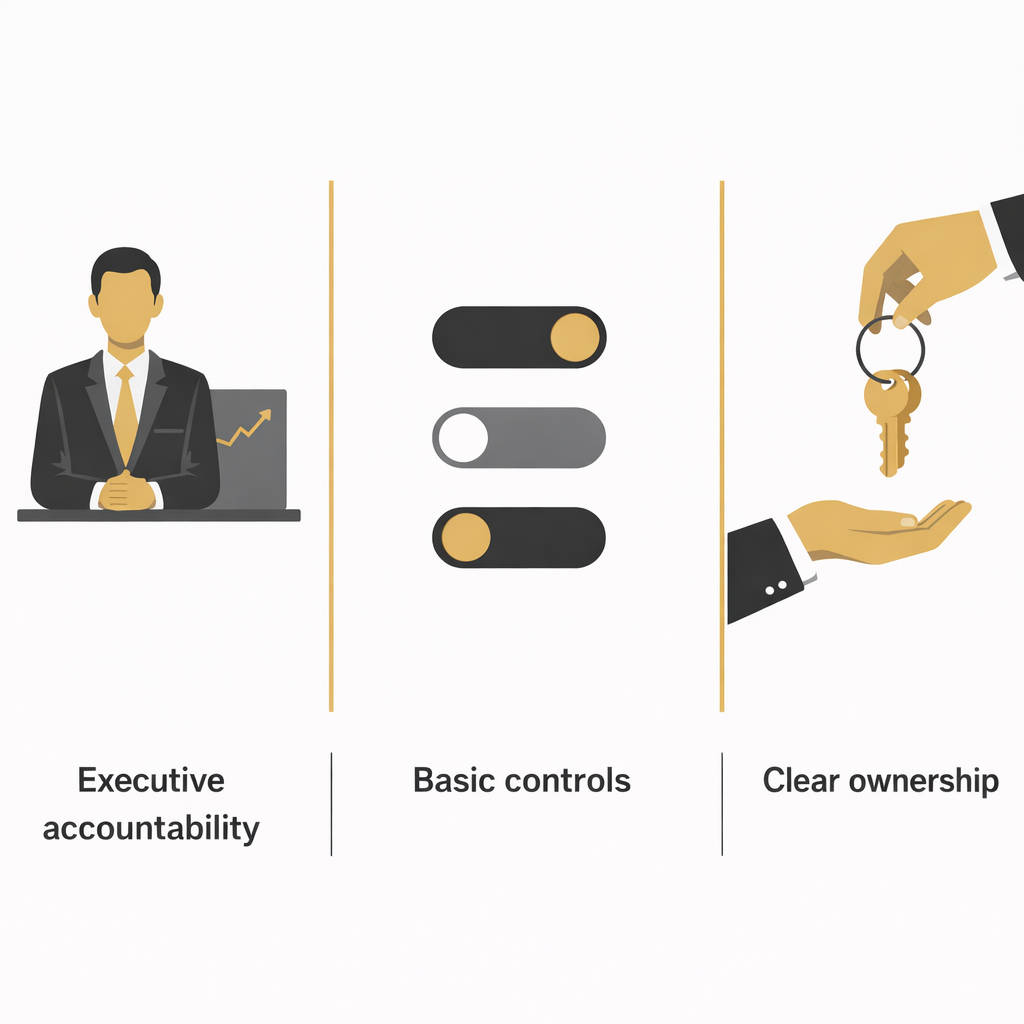
This is why cyber resilience needs executive ownership. It is not enough for senior leaders to ask whether IT has sorted cyber. They need to understand what the organisation relies on, what risks exist, which controls matter, and what evidence shows those controls are working.
Get the basics right first
Most organisations do not need to start with complex security projects. They need to get the basics right and make sure those basics are maintained.
That means knowing what devices, systems and cloud services are in use. It means keeping software up to date, using strong authentication, limiting access, controlling administrative privileges, removing unused accounts and making sure staff understand what is expected of them.
These controls are not glamorous, but they matter. They are also the areas where organisations often fail because responsibility is unclear, records are weak, or controls are assumed rather than evidenced.
The executive question is simple:
Can the organisation prove that basic cyber controls are in place, owned, reviewed and working?
Ownership needs to be visible
Cyber resilience improves when ownership is clear. Policies, registers, controls and risk assessments only add value when people know who is responsible for maintaining them.
For executives, this means moving from oversight to ownership. Oversight is asking for updates. Ownership is making sure the organisation has clear responsibilities, proportionate controls, useful evidence and a process for dealing with gaps.
A strong approach does not require every director to become a technical specialist. It does require leaders to understand the business impact of cyber risk and to ask the right questions.
The questions leaders should be asking
Senior leaders should be asking questions that test whether cyber security is being managed as part of normal business governance.
- Do we know what systems, devices and cloud services are in scope?
- Who owns cyber risk at leadership level?
- Are critical controls documented and reviewed?
- Do we know who has access to important systems?
- Are suppliers creating risks we have not reviewed?
- Do we have evidence, or are we relying on assumptions?
- Would we know what to do during a cyber incident?
These questions are not just compliance questions. They are business resilience questions.
Cyber Essentials gives leaders a practical baseline
Cyber Essentials is a useful starting point because it focuses on baseline technical controls that protect against common cyber threats. It gives organisations a structured way to assess whether the basics are in place.
For leaders, Cyber Essentials can support supplier assurance, procurement requirements, contract readiness and cyber insurance expectations. It also gives a clearer route for identifying where practical controls need improvement.
Certification alone does not make an organisation resilient, but it can provide a disciplined starting point. The value comes from understanding the controls, maintaining them and making sure they are owned properly.
Evidence matters
One of the biggest gaps in many organisations is evidence. Leaders may believe controls are in place, but there may be no reliable record to prove it.
Good evidence does not need to be excessive. It needs to be clear, current and connected to responsibility. That might include asset records, access reviews, patching evidence, policy approvals, supplier checks, incident records and management review notes.
Evidence helps the organisation answer an important question: if a customer, insurer, auditor or board member asked how cyber risk is being managed, could we show them?
Culture follows leadership behaviour
Staff take cyber security more seriously when they see leaders taking it seriously. If cyber security is only mentioned after an incident, it becomes reactive. If it is built into governance, supplier decisions, onboarding, risk review and business planning, it becomes part of how the organisation operates.
Change starts from the top because leadership sets the tone. Leaders decide whether cyber security is treated as a blocker, a tick-box activity or a business resilience requirement.
The strongest organisations are not the ones that claim to have no risk. They are the ones that understand their risk, assign ownership, maintain basic controls and improve when gaps are found.
Watch the webinar: From Oversight to Ownership
This blog is based on the PCS webinar From Oversight to Ownership, which explains executive accountability in cyber resilience and what business leaders need to understand about cyber ownership, Cyber Essentials, supplier assurance, incident readiness and evidence.
Watch the webinar:
https://youtu.be/iObEc4ItYIM
Explore Cyber Essentials support:
https://www.positivecybersolutions.co.uk/cyber-essentials/
Explore ISO 27001 support:
https://www.positivecybersolutions.co.uk/iso-27001/
Explore AI Governance support:
https://www.positivecybersolutions.co.uk/ai-governance/